
FlashHub: one catalogue for trade and retail luxury watch buyers
FlashHub gives a Swiss luxury retailer one shared catalogue for watches and jewellery — serving trade accounts and individual shoppers from a single storefront.
The Challenge
A luxury retailer selling watches, jewellery and gifts usually ends up running two businesses: a boutique-style storefront for individual buyers, and a wholesale process for trade accounts, bulk orders or resellers, often on two different systems with the same products entered twice.
The two audiences also want different things from the same product page. A trade buyer wants a reference number, a quantity field and a quote. A retail shopper wants photography, material and movement detail, and enough reassurance to spend several hundred or several thousand francs on something they cannot hold before buying.
Luxury catalogues are unusually fragmented at the variant level: the same watch splits into case size, strap material, dial colour and movement, each with its own stock and price, and a storefront that flattens all of that into one generic listing loses exactly the difference a buyer is paying for.
The Solution
One catalogue, two ways to buy
Every watch, ring or gift piece exists once in the catalogue, with a retail price for individual buyers and trade terms for wholesale accounts drawn from the same record. A trade account signs in and sees a quantity field and a quote tool; a retail shopper sees a single-item cart. Neither view is a separate system copying data from the other.
A product page built for a considered purchase
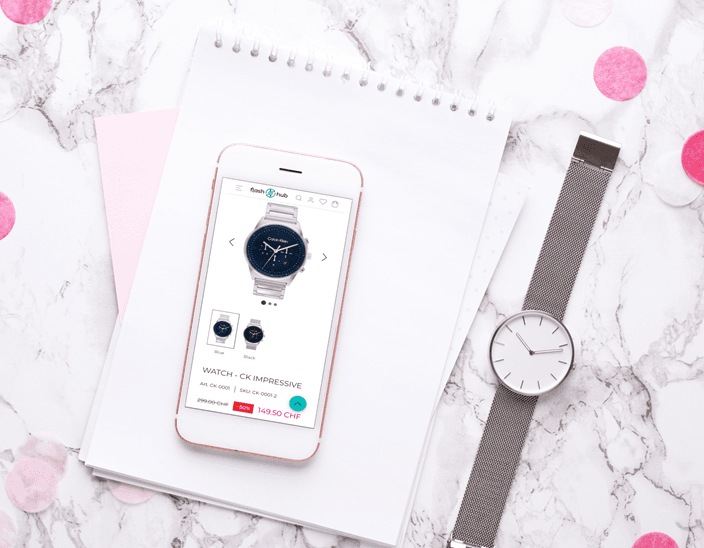
High-value items sell on detail, not on urgency: full photography, material and movement information, and a layout that gives a shopper the confidence to check out without holding the piece first. The retail side is built around that pause before a large purchase, not around filling a cart as fast as possible.
Variants that stay distinct instead of collapsing into one listing
Case size, strap material, dial colour and movement each carry their own price and stock rather than being folded into a note in a generic product description. A shopper comparing two straps on the same watch is comparing two real, priced, in-stock options, not guessing from a paragraph of text.
Navigation built for browsing, not for a parts list
Wholesale software tends to assume the buyer already knows what they want and is searching by reference number. The retail side does the opposite: browsing by brand, by occasion or by price range, the way someone actually shops for a watch or a gift, while the trade side keeps the reference-number search a wholesale buyer expects.